4D Gaussian Splatting Explained: Extending 3DGS to the Time Domain
A step-by-step introduction to 4D Gaussian Splatting — how adding a time dimension to 3DGS enables real-time dynamic scene rendering, from deformation fields to temporal regularization.
Level: Intermediate | | Research area: Dynamic 3D reconstruction | Prerequisite: Gaussian Splatting Explained (W14)
Companion Notebook
| Notebook | Topic |
|---|---|
| 00_4d_gaussians_from_scratch.ipynb | Pure NumPy deformation-based 4DGS on synthetic data |
1. From Photographs to Movies
In the W14 basics, we learned that 3D Gaussian Splatting (Kerbl et al., 2023) reconstructs a frozen moment from a set of photographs. You point a camera at a scene, capture multiple views, and 3DGS gives you a real-time, high-fidelity 3D representation you can render from any angle.
But the world is not frozen. People walk, objects fall, lighting changes. Leaves sway in the wind. Clothes deform as an actor moves. If you try to apply 3DGS to a video sequence frame-by-frame, you'll get flickering and artifacts because each frame's Gaussians are learned independently, with no awareness of motion continuity.
This is where 4D Gaussian Splatting comes in. By adding a temporal dimension, we learn Gaussians that change over time. Instead of "here's what the scene looks like at frame 42," we say "here's how the scene evolves from frame 1 to frame 100." The result: real-time rendering of dynamic scenes, often at 30–60+ FPS.
This article explains the core ideas and strategies. The companion notebook builds a working deformation-based 4DGS model from scratch, showing exactly how temporal deformation works.
2. Quick Recap: What Is a 3D Gaussian?
If you've read the W14 basics, you know the essential parts. A 3D Gaussian in space is defined by:
- Position:
- Covariance: (shape and orientation), usually factored as rotation (quaternion) and anisotropic scale — per-axis scaling is what lets one Gaussian cover a thin wall or a long hair strand instead of packing many spheres to do the same job
- Opacity:
- Color: Spherical harmonic (SH) coefficients
Rendering works by:
- Projecting each Gaussian to 2D screen space
- Sorting by depth
- Alpha-compositing in order
The entire pipeline is differentiable, so we can backprop photometric losses through the renderer and update the Gaussian parameters.
For a refresher on the math and why splatting is fast, see Gaussian Splatting Explained (W14).
3. Adding Time: The Core Idea
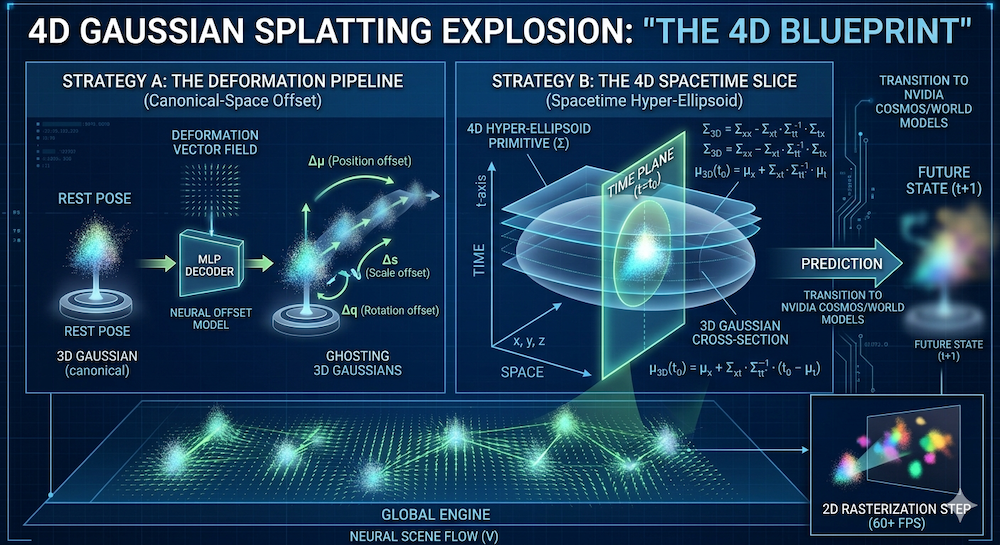
To extend 3DGS to dynamic scenes, the key insight is simple: make every Gaussian property a function of time .
Instead of fixed , we now have:
At each frame, we evaluate these functions at the frame's timestamp and render as usual.
But how do we learn these time-dependent functions? Two strategies have proven effective:
- Deformation fields: Start with canonical Gaussians and learn a time-dependent offset.
- 4D Gaussians: Treat time as a 4th spatial dimension and condition on the render-time to slice out a 3D Gaussian.
Let's explore both.
3.1 Strategy A: Deformation Fields
The deformation field approach is the most practical and widely adopted.
Idea: Keep a canonical set of Gaussians (think of them as a "rest pose"). Then, learn a function that predicts how each Gaussian deforms at time . In practice, most deformable-3DGS variants deform geometry only (position, rotation, scale) and keep appearance (opacity, color) static — this covers most motion (people walking, objects falling, cloth swaying) while keeping the deformation network small. Methods that also want time-varying lighting or color add a second, appearance-specific deformation head.
At time , the deformed Gaussian position is:
Similarly for rotation and scale. The deformation function is typically a small MLP or other function approximator, applied per-Gaussian.
Training pipeline:
- Initialize canonical Gaussians (e.g., from frame 0 or the scene's mean)
- For each training frame at time :
- Evaluate to get offsets
- Deform Gaussians using offsets
- Render the deformed Gaussians
- Compute photometric loss against the ground-truth frame
- Backprop through the renderer and the deformation function
This approach is described in Yang et al., 2024 (Deformable 3DGS). The deformation function can be as simple as a learned linear model or as complex as a neural network, depending on the scene's motion complexity.
3.2 Strategy B: 4D Gaussians
An alternative, more mathematically unified approach is to work directly in space.
Idea: Each Gaussian now has a 4D covariance matrix . It describes the extent and orientation of the Gaussian not just in space, but also in time.
Geometric picture: slicing a 4D ellipsoid. Think of the level set of a 4D Gaussian as an ellipsoid in space. Rendering at a specific timestamp means cutting that 4D ellipsoid with the hyperplane — the cross-section is a 3D ellipsoid, which is exactly the 3D Gaussian you want to rasterize. Slice, not squash. Marginalizing out would flatten (integrate) the 4D ellipsoid into its static 3D shadow — effectively producing a "motion blur" that accounts for the Gaussian's existence across all time rather than its state at a specific instant. Conditioning on is the right operation, and it's cheap: a closed-form formula, no MLP call.
Mathematically, conditioning a 4D Gaussian on yields a 3D Gaussian with mean and covariance:
where is the spatial block of , is the temporal variance, and couples space and time. The mean drifts over time through — that is how a 4D Gaussian encodes motion without an explicit deformation network. The covariance shrinkage (a Schur complement) is what's left of the spatial ellipsoid after the temporal direction has been pinned to .
The PSD catch. Both formulas above silently assume is positive semi-definite throughout training — otherwise isn't defined and the sliced covariance can blow up. Following the 3DGS convention, implementations parameterize (the 4D analogue of the quaternion-rotation + anisotropic-scale factorization from §2), which guarantees PSD by construction under any gradient update. In the 4D analogue, is a rotation matrix — unlike the 3D case where a single quaternion (4 parameters) suffices, 4D rotations have six degrees of freedom and are often handled via a pair of quaternions (left- and right-isoclinic rotations, sometimes called "4D rotors") or an explicit 6-parameter representation. This parameterization is what makes 4D Gaussians trainable in practice; drop it and numerical stability becomes the dominant failure mode.
This approach is presented in Wu et al., 2024 (4D Gaussian Splatting). The advantage is elegance and a unified representation; the disadvantage is that a single 4D primitive implicitly assumes unimodal temporal support, so motion that is long, nonlinear, or reappearing after occlusion typically needs multiple 4D Gaussians to cover — and the 4D covariance has to be parameterized carefully to stay PSD.
4. Training a 4DGS Model
Let's walk through a typical training loop (using deformation fields, the more common approach).
Input: Multi-view video (or monocular video with estimated camera poses)
For each training step:
- Sample a frame at time and a camera viewpoint
- Deform: Evaluate the deformation function for each Gaussian to get position , rotation , scale
- Render: Use the standard splatting pipeline to render the deformed Gaussians to a 2D image
- Photometric loss: Compare the rendered image with the ground-truth frame: where is the rendered image and is the ground truth
- Backpropagate: Gradients flow through the renderer, the deformation function, the Gaussian parameters, and the MLP weights
- Update: SGD or Adam on all learnable parameters
The key difference from 3DGS is step 2 and the fact that the deformation function is now part of the computational graph.
Strategy A vs. Strategy B at a glance:
| Feature | Strategy A (Deformation) | Strategy B (4D Spacetime) |
|---|---|---|
| Logic | Canonical splat + MLP offset | Spacetime ellipsoid slice at |
| Per-frame cost | MLP eval + rasterize | Matrix ops + rasterize |
| Best for | Articulated motion (humans, hands) | Fluid / smooth motion (smoke, water) |
| Training stability | High — robust MLP optimization | Medium — needs PSD constraints on |
In practice, many recent systems hybridize: a coarse 4D Gaussian provides the global trajectory and a lightweight deformation head corrects local detail.
5. Why Temporal Regularization Matters
Without constraints, the deformation function can do whatever it wants: it might make Gaussians teleport, spin wildly, or vanish between frames. This overfitting looks terrible.
Temporal regularization penalizes non-physical motion. Common regularizers include:
-
Velocity smoothness: Penalize the difference between deformations at adjacent frames: This encourages gradual, continuous motion.
-
Local rigidity: Nearby Gaussians should move similarly. This is based on the assumption that a rigid body part should deform coherently:
-
As-rigid-as-possible (ARAP): A more sophisticated constraint: preserve local distances and angles between Gaussians. This is inspired by physics-based deformation and is particularly useful for cloth and skin.
Why does this matter? Think of it like a physics engine. Without temporal regularization, each frame is independent—like having no constraints on your simulation. With temporal regularization, you're adding springs and stiffness, ensuring that the motion is smooth and plausible. The regularization weight is a tuning knob: higher means stiffer, slower motion; lower means more flexibility and faster adaptation to the data.
The total training loss is:
6. Rendering Dynamic Scenes in Real Time
One of the biggest wins of 4DGS over competing dynamic NeRF methods is speed.
Static 3DGS achieves 100+ FPS because splatting is embarrassingly parallel on the GPU. Each Gaussian is independent, so you can parallelize across thousands of Gaussians with ease.
4DGS adds exactly one step: evaluate the deformation function at time before rendering. Since the deformation MLP is tiny (typically 2–3 layers, a few hundred parameters), this is negligible:
The deformation eval is microseconds; splatting dominates, just like in 3DGS.
Result: 4DGS renders at 30–60+ FPS, depending on scene complexity. Compare this to the rough numbers reported in the original dynamic-NeRF papers:
| Method | Approx. FPS | Approach |
|---|---|---|
| D-NeRF | ~0.1 | Full NeRF network + deformation MLP |
| Nerfies | ~0.5 | Deformation on learned NeRF features |
| 4DGS | 30–60+ | Deformation on Gaussians + splatting |
These are order-of-magnitude comparisons — exact numbers depend heavily on scene size, resolution, and hardware, so always consult the source papers for benchmarks in your setup. The order-of-magnitude takeaway holds: 4DGS makes dynamic scene rendering interactive for the first time.
2026 context: The ~100× speedup over D-NeRF has made 4DGS the de facto standard for real-time digital twin generation. Autonomous-driving pipelines, sports broadcast replay, and AR try-on systems that were previously NeRF-bottlenecked have largely migrated to Gaussian-based backends, and the gap continues to widen as custom CUDA splatting kernels mature.
7. Current Limitations and Open Problems
4DGS is powerful, but not a silver bullet.
-
Long sequences: Memory and computational cost scale with video length. High-quality reconstruction over minutes of footage is still challenging. Some approaches use hierarchical or streaming methods to mitigate this.
-
Topology changes: When objects appear or disappear (e.g., a door opening), a pure deformation field struggles because it assumes a fixed set of Gaussians. You'd need to explicitly handle creation/deletion of Gaussians, which is an active research area.
-
Monocular video: Without multiple views, depth is ambiguous. 4D reconstruction from a single camera is ill-posed unless you use strong priors (e.g., assume the scene is human-shaped). This is why most 4DGS methods target multi-view video or require camera poses.
-
Editing and control: How do you modify a single object (e.g., move the actor's arm) without affecting the rest of the scene? SC-GS (Huang et al., 2024) addresses this by segmenting Gaussians, but it's still an open problem.
-
Scale: City-scale dynamic scenes with multiple moving objects remain unsolved. Today's 4DGS works best on object-centric or room-scale scenes.
8. What We Build in Notebook 00
The companion notebook implements a deformation-based 4DGS from scratch, in NumPy, no frameworks.
Setup:
- Synthetic data: 50 Gaussians following a mix of sinusoidal, linear, and circular trajectories (circular is the hard case — it requires the MLP to learn nonlinear time dependence)
- 2D orthographic projection — we intentionally drop perspective so the math stays focused on the temporal side; the notebook's engineering callouts explain when and why this simplification breaks down
- Pure NumPy forward pass (no autodiff framework)
- Explicit hand-written backprop — every shape and every ReLU derivative, no finite differences
You'll implement:
- Initialization of canonical Gaussians
- A 2-layer ReLU deformation MLP (64 hidden units, ~4.5k parameters)
- Forward pass: deform → orthographic-project → compute MSE loss against noisy 2D observations
- Training loop with gradient accumulation across timesteps and cosine learning-rate decay
- Velocity regularization and its jerk-vs-fidelity tradeoff
- Visualization: side-by-side comparison of static (3DGS-style) vs. time-aware (4DGS-style) rendering — the dynamic model beats the static baseline by ~39%
By the end, you'll see why motion matters: the static reconstruction flickers; the 4DGS reconstruction flows smoothly. And you'll have built it with no black boxes, just math and NumPy.
Summary
-
3DGS captures a frozen moment. 4DGS captures a movie. By making Gaussian properties functions of time, we unlock dynamic scene rendering.
-
Two main strategies: Deformation fields (practical, fast) and 4D Gaussians (elegant, sometimes less stable).
-
Temporal regularization is crucial. Without it, Gaussians overfit to individual frames. With it, motion is smooth and plausible.
-
Still real-time: Adding a deformation function adds microseconds. Splatting remains the bottleneck and remains fast. 30–60+ FPS is achievable even for complex dynamic scenes.
-
Open problems remain: Long sequences, topology changes, monocular reconstruction, and scene-scale editing are still active research areas.
The next step—moving from basics to trend analysis—will explore where dynamic scene understanding is heading: world models, multi-object tracking, and the path toward general video understanding.
Further Reading
Core papers:
- 3D Gaussian Splatting for Real-Time Radiance Field Rendering — Kerbl et al., 2023
- 4D Gaussian Splatting for Real-Time Dynamic Scene Rendering — Wu et al., 2024
- Deformable 3D Gaussians for High-Fidelity Monocular Dynamic Scene Reconstruction — Yang et al., 2024
- Dynamic 3D Gaussians: Tracking by Persistent Dynamic View Synthesis — Luiten et al., 2024
Related and alternative approaches:
- SC-GS: Sparse-Controlled Gaussian Splatting for Editable Dynamic Scenes — Huang et al., 2024
- D-NeRF: Neural Radiance Fields for Dynamic Scenes — Pumarola et al., 2021
- Nerfies: Deformable Neural Radiance Fields — Park et al., 2021
- HyperNeRF: A Higher-Dimensional Representation for Topologically Varying Neural Radiance Fields — Park et al., 2022
Prerequisites & related artifocial tutorials:
- Gaussian Splatting Explained (W14 Basics) — the 3DGS prerequisite for everything above.
- The 4D Gaussian Frontier (W16 Trend Tutorial) — practitioner-level survey of the whole 4D-GS landscape, including Dynamic 3D Gaussians, SC-GS, and the connection to world models.
- Beyond Attention — Post-Transformer Architectures (W15) — SSMs and equivariant networks that are natural temporal backbones for deformation fields on long video sequences.
Stay connected:
- 📧 Subscribe to our newsletter for updates
- 📺 Watch our YouTube channel for AI news and tutorials
- 🐦 Follow us on Twitter for quick updates
- 🎥 Check us on Rumble for video content